
2026-10-29 · by Sable, Founding team, Anon eSIM
eSIM cards USA: types, costs and how to choose
eSIM cards in the USA explained: the four types, which phones support them, how activation works, typical costs, and which option suits residents or visitors.
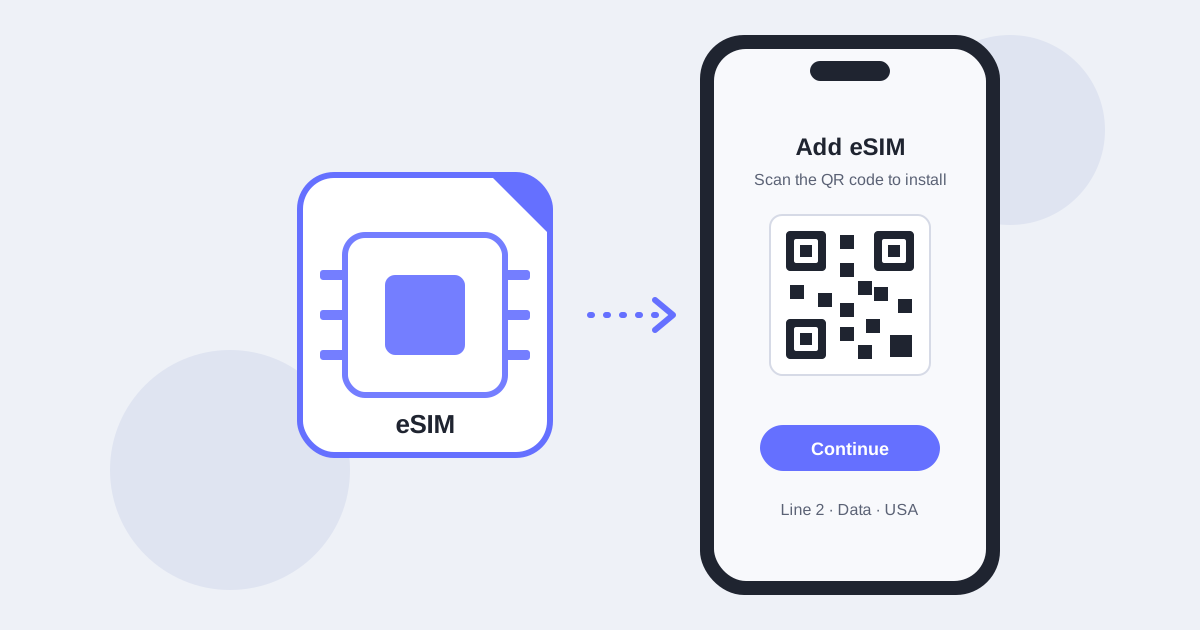
If you're comparing the eSIM cards USA carriers sell, the first thing to know is that an eSIM isn't really a card. It's a digital SIM profile you download to a chip that's already built into your phone, usually by scanning a QR code or tapping through a carrier app. In the US you can get one from a major carrier, a prepaid brand, or a travel eSIM provider, and the right choice depends on whether you live in the US or are just visiting.
This guide explains how the eSIM cards USA travelers and residents use actually work: the main types you can buy, which phones support them, how activation works, what each option asks for, rough costs, and what to do if your phone has no eSIM.
One thing to be upfront about: Anon eSIM sells one of the options on this page, a data-only travel eSIM. It's a good fit for visitors and short trips, not for someone who needs a long-term US phone number. We say where each type fits so you can choose for yourself.
What are the eSIM cards USA carriers sell?
They're downloadable SIM profiles, not plastic cards, and most phones sold in the US can now store them.
"eSIM" stands for embedded SIM. Instead of a removable card, your phone has a small chip (the eUICC) that can hold one or more carrier profiles. Buying an eSIM means getting a profile for that chip, and the provider sends you a QR code, a link or an in-app prompt to install it.
People still say "eSIM card" because it replaces the SIM card. The practical differences are simple:
- Nothing to ship or insert. You can buy and install from anywhere with an internet connection.
- More than one line. Many phones can store several eSIM profiles and use two lines at once.
- Harder to lose. There's no tiny card to drop when you swap SIMs at an airport.
In the US, eSIM is now the default on many phones. Apple removed the SIM tray from US models starting with the iPhone 14, so those iPhones only work with eSIM.
Which eSIM cards USA providers offer, and who are they for?
There are four main types, and they differ mostly in who they're built for and what they ask from you.
| Type | Best for | US phone number? | What you usually need | How you buy |
|---|---|---|---|---|
| Carrier eSIM (postpaid) | US residents on a monthly plan | Yes | US address, ID, often a credit check | Carrier app, website or store |
| Prepaid / MVNO eSIM | Residents who want no contract | Yes | US address, payment card | Brand app or website |
| Travel eSIM | Visitors and short trips | Usually no (data-only) | Varies; some need only payment | Provider website or app |
| eSIM adapter card | Phones without built-in eSIM | Depends on the profile | A compatible phone (often Android) | Bought as a physical card, then loaded with profiles |
The first two are what most people living in the US use. The third is what most visitors use. The fourth is a niche workaround for older phones.
Does your phone support a US eSIM?
Most recent iPhones and many recent Android phones do, but the phone also has to be unlocked to use another provider's eSIM.
Check two things before you buy:
- eSIM support. Dial
*#06#. If you see an EID number, your phone has an eSIM chip. On iPhone you can also look for Add eSIM under Settings > Cellular. - Unlocked status. A phone that's locked to one carrier won't accept another carrier's eSIM. On iPhone, go to Settings > General > About and look for "No SIM restrictions" next to Carrier Lock. If you're unsure, ask your carrier.
Phones bought outside the US can also have different network bands, which can affect rural coverage. Our compatible devices page lists the models Anon eSIM supports.
How do you get an eSIM from a US carrier?
For a carrier or prepaid line, you sign up, verify your details, and then install the eSIM from the carrier's app or a QR code.
The exact steps vary by carrier, but the flow is usually the same:
- Choose a plan. Pick a postpaid or prepaid plan on the carrier's website or app.
- Provide your details. Expect to give a US address and a payment card. Postpaid plans often add an identity or credit check.
- Keep or get a number. You can transfer (port) an existing US number or get a new one.
- Install the eSIM. The carrier app usually installs it directly. Otherwise, scan the QR code they send.
- Set your lines. On a dual-SIM phone, choose which line handles calls, texts and data.
This route is the right one if you live in the US and need a US number for banking, deliveries and two-factor codes.
What are the best eSIM cards USA visitors can use?
For most visitors, a data-only travel eSIM is the simplest option, because it works on arrival without a US address.
US carrier and prepaid sign-ups are built around a US billing address, which is awkward for tourists. A travel eSIM is bought online, installed before you fly, and roams onto US networks when you land.
Anon eSIM, for example, works on Verizon, AT&T and T-Mobile in the US at $2.80/GB, billed per megabyte from a USD balance that never expires. There's a one-time $5 setup fee, a $5 minimum top-up, and hotspot is included. It doesn't give you a US phone number.
If you're visiting, these two guides go deeper:
- Best eSIM for visitors to the USA compares it with US prepaid on price, coverage and speed.
- USA eSIM for tourists with no ID or SSN covers why US prepaid is hard for visitors.
How much does an eSIM in the US cost?
It depends on the type: monthly plans for residents, and per-GB or fixed bundles for travelers.
As a rough guide, from the prices quoted in our earlier US guides:
- US prepaid "unlimited" plans: around $50–$70 a month, with a US address required.
- Small prepaid data plans: around $15 for 5 GB on some carriers, also needing a US address.
- Travel eSIM bundles: often in the mid-teens for about 5 GB over 30 days.
- Anon eSIM: $2.80/GB, so 3 GB is $8.40 and 8 GB is $22.40, plus the one-time $5 setup fee on a new eSIM.
Prices change often, so check each provider's current terms. For heavy use over a month or more, a US prepaid plan can work out cheaper per GB than any travel eSIM.
What if your phone doesn't support eSIM?
You can use a physical SIM, or a removable "eSIM adapter" card that holds eSIM profiles in your phone's SIM slot.
An eSIM adapter is a SIM-shaped card with its own reprogrammable chip. You load eSIM profiles onto it with a companion app or a USB reader, then insert it like a normal SIM.
These cards work best with Android phones. They cost extra, setup is more involved than a built-in eSIM, and not every profile or phone works with them. If your phone is older and you're only traveling, a local physical SIM may be simpler.
What does each eSIM type ask from you?
Carrier and prepaid eSIMs are tied to your identity and address; some travel eSIMs ask for very little.
- Carrier plans usually need your name, address, payment card and sometimes a credit check.
- Prepaid brands usually need a US address and a payment card.
- Travel eSIMs vary. Many ask for an email and account; some also want ID for certain destinations.
- An anonymous eSIM such as Anon eSIM asks for no ID and no account at checkout. Your payment provider and the mobile networks still see their own data, such as payment details and your device's identifiers.
Frequently asked questions
Is an eSIM the same as a SIM card? It does the same job, but it's digital. Instead of inserting a card, you download a profile to a chip built into the phone.
Can I use a US eSIM on a phone bought abroad? Usually, if the phone supports eSIM and is unlocked. Network band support varies by model, so coverage in rural areas can differ.
Do US iPhones still have a SIM tray? No. US iPhone 14 models and later are eSIM-only, so they can't take a physical SIM card.
Can I keep my home number while using a US eSIM? Yes, on a dual-SIM phone. Keep your home line for calls and texts, and use the US eSIM for data. Your home carrier may charge for calls and texts while you're abroad.
Which US eSIM option is cheapest? The cheapest eSIM cards USA shoppers can find depend on how much data you use and for how long. For a short trip, per-GB billing often costs less; for a month of heavy use, a US prepaid plan can be cheaper.
The bottom line
Choosing between the eSIM cards USA carriers and travel providers sell comes down to why you need one. If you live in the US and need a number, go with a carrier or prepaid eSIM. If you're visiting, a data-only travel eSIM installed before you fly is usually the easiest option.
If you're planning a trip, you can check the current US rate on the United States eSIM page or read how Anon eSIM works.
About the author: Sable
Sable is the pseudonymous founding writer at Anon eSIM. Ten years in mobile infrastructure and payments; now writes about travel connectivity, roaming economics, and practical privacy. Pseudonymous by choice - fitting for a company whose entire product is not knowing who you are.
More about Anon eSIM →Related reading
- How to call USA from Australia: codes, costs and tips →How to call USA from Australia: dial 0011 or +, then 1 and the 10-digit number. Landline and mobile examples, costs, free app calls and the time difference.
- Red phone signal: what it means and how to fix it →What a red phone signal means on iPhone and Android, the usual causes, step-by-step fixes at home and abroad, and the red icons that aren't signal problems.
- How to use an eSIM for international travel, step by step →Going abroad from the U.S.? Learn how to check your phone, pick a plan, install a travel eSIM before you fly, and fix the most common problems on arrival.
- eSIM Italy guide: the benefits of a tourist eSIM for U.S. travelers →How a tourist eSIM works in Italy, what it costs, how to choose a plan, and the limitations U.S. travelers should know before they fly.